How IPaadress.ee was rebuilt
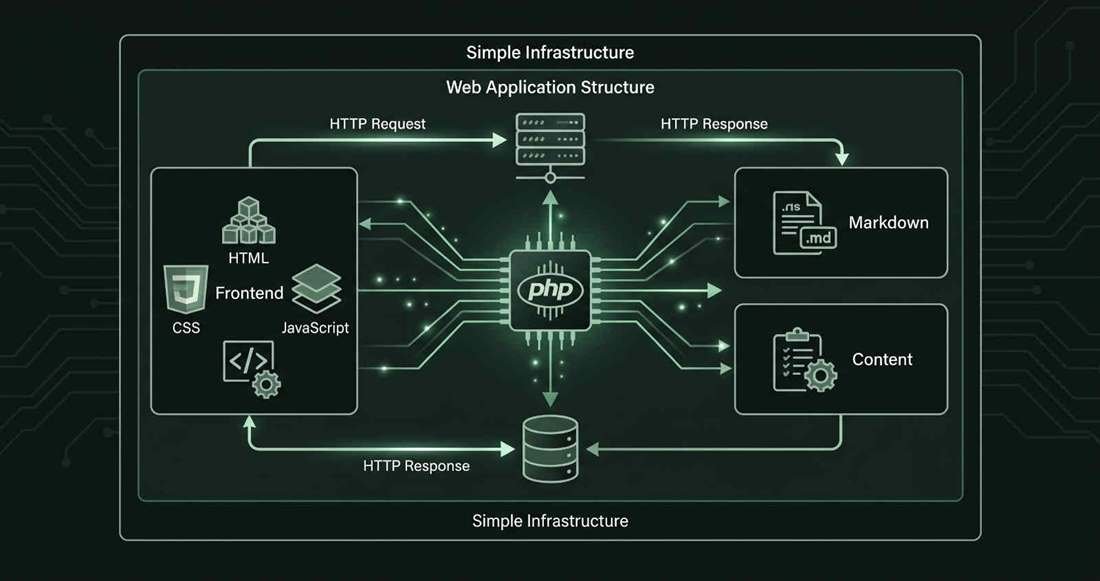
IPaadress.ee still does one job: it shows the public IP address your connection uses to reach the internet, and it offers a speed test. In autumn 2026 the site itself was rebuilt. The work started from the old pages, became a single application, and then was tuned until Google Lighthouse scores 100 for performance, SEO, best practices and accessibility.
What came before
The site was an older PHP installation. The home page, the speed test and the explanatory text lived at separate addresses, including URLs that ended in .php. The layout came from an older template: a menu, a header and a footer were there, but the site was not one application.
The project contained files that no page loaded, including old libraries and an unused stylesheet. The CSS named the fonts Ubuntu and Droid Serif, but those fonts were never downloaded. Visitors were already seeing Arial. White text on a light green background was short on contrast. Dates were shown in the machine form YYYY-MM-DD. The primary content had no main landmark for a screen reader to jump to. The security headers covered only part of the risk.
The first rebuild
The first step made the site one application. Every address goes through a single front controller. The old .php addresses redirect permanently to the new ones.
The text is in Estonian, English and Russian. Each page has a canonical address, language alternates and a language switcher. The blog is Markdown files: a list, an article and a link between translations. The home page reads the visitor’s address only from the connection, not from forwarded headers. The speed test stayed an OpenSpeedTest widget. The sitemap lists the pages and the articles. The privacy policy states that the IP address is not stored or shared.
Fine-tuning
The next pass was appearance, accessibility and headers.
White text on light green became a darker green on the logo, the active menu item and the IP address box. Links stay teal at rest and turn dark green on hover. Blog links use that same green. The active menu item and the hover state have rounded corners. The footer is dark green-gray rather than blue. Dates in the blog and the privacy policy are shown as DD.MM.YYYY. The machine-readable date and the sitemap stayed in ISO form.
The page gained one main landmark and a keyboard link, “Skip to main content”. The skip link is visible only when it has focus. Fonts are Arial, Helvetica and generic sans-serif throughout. Unused files were removed from the project.
The security headers were tightened. The content security policy allows scripts only from this site, plus one theme script in the header matched by its hash. The page is isolated from other windows that might open it. The browser refuses script injection through the DOM. There are no tracking cookies. A notice in the corner says so in three languages, and dismissing it is remembered only in that browser, without a cookie.
The result
The page does the same work as before: it shows an address and measures a connection. The difference is how it is put together. One application, three languages, readable contrast, landmarks, fonts that are actually used, and stricter headers. The end of that work can be measured. Google Lighthouse gives IPaadress.ee 100 for performance, SEO, best practices and accessibility.
Author
The author of IPaadress.ee, and the person who rebuilt it, is Toomas Pai. He manages, maintains and builds websites as eeweb Studio. Rebuilding this site was a professional challenge: to make a web application that is as simple as possible and still works, that reaches the top of the Google Lighthouse scores, that does not track the visitor or collect their data, and that is a trustworthy local way to check an IP address.